# Workshop introduction
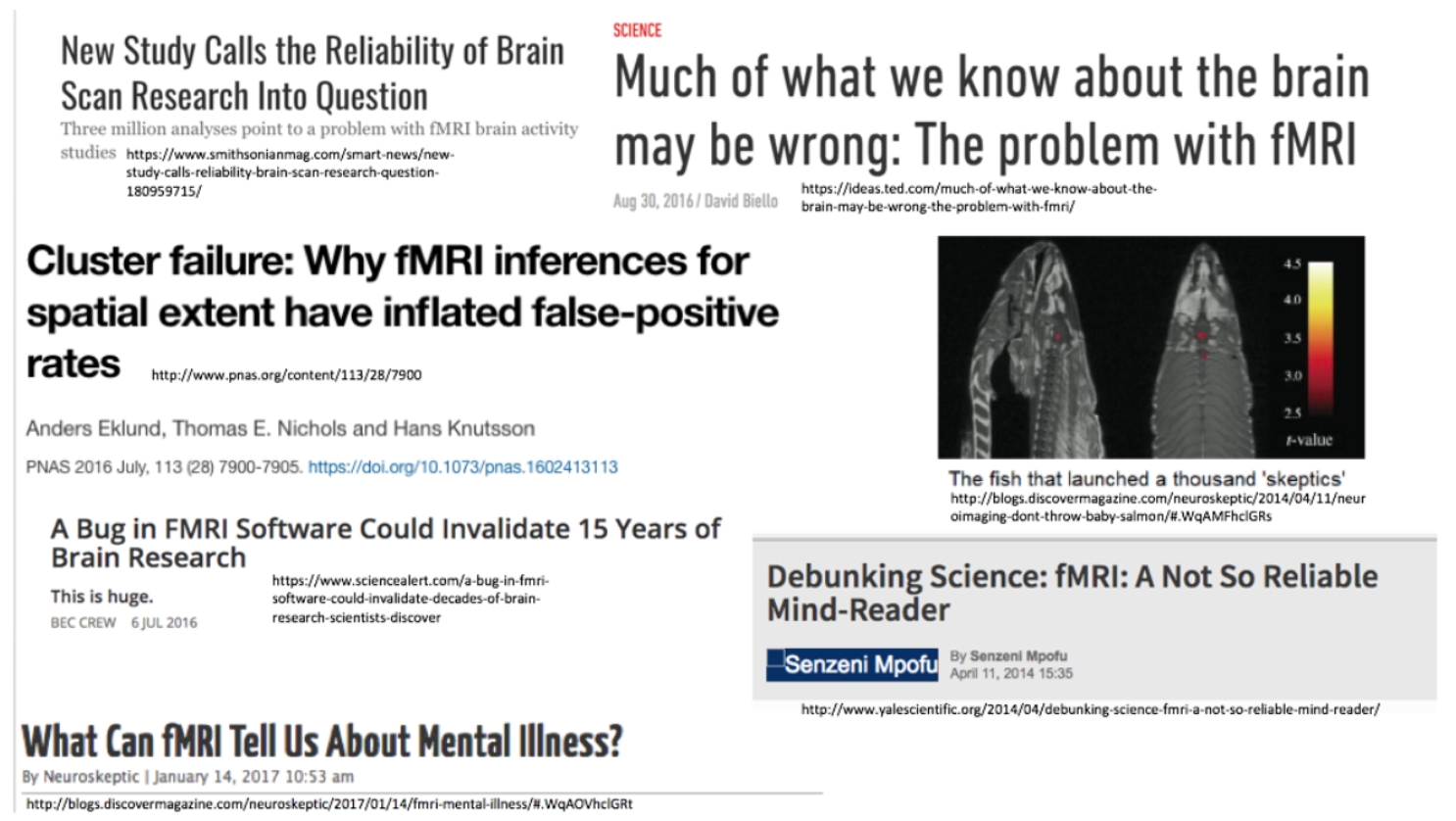
If the last couple of years of `neuroimaging` made one thing clear it's that this research field (like basically all others) has a major problem concerning the `reproducibility` of results. Given the tremendously complex `analyses` we apply to tremendously complex and noisy `data` and that rely on convoluted `software` stacks, as well as are marked by an almost infinite amount of degrees of freedom, every little thing we do and change can have a prominent impact on subsequent steps and results. It is not only contrary to what science should be, wastes an incredibly large amount of resources and funding but also poses great problems concerning advancing our understanding of the human brain and thus ability to help people.
 So, what should we do? Give up? Just continue and hope for the best? Hard no! There's actually quite a bit one can do to tackle these problems and make `neuroimaging` more `reproducible`. The problem is: there are also quite a bit of problems that need to tackled, distributed along the entire `research workflow`. Additionally, most researchers, no matter their career stage, are not trained concerning these aspects. This is where `ReproNim` and adjacent initiatives come in: everything matters and researchers should be the trained accordingly, with the training being provided openly and freely, as well as guided and supported by resources and tools. Within this workshop, we would thus like to present an introduction and overview into the important topic of `reproducible neuroimaging` divided into [basics](http://www.repronim.org/DGPA_workshop_2022/basics.html) and [advanced concepts](http://www.repronim.org/DGPA_workshop_2022/advanced.html). Based on a mixture of theoretic background and practical hands-on sessions we aim to provide participants with a holistic understanding of the problem and first experience to then continue further and apply the respective approaches in their own `research workflows`.
## Content 💡👩🏽🏫
In the following you'll find the `objectives` and `materials` for each of the topics we'll discuss during this session. Being the introduction to the workshop, we will have a few `slides` to give participants an overview of the content of the workshop, the schedule, setup, etc. . Additionally, we will provide a bit of information concerning [ReproNim](https://www.repronim.org/) and also answer questions!
#### Objectives 📍
- Get an overview of the workshop and its content
- Learn about the different topics, setup and communication options
- Answer questions
#### Materials 📓
You can find the `introduction slides` below or can directly [download](https://docs.google.com/presentation/d/1V8isbmxYwRBRrz1avViFZYEeKOmzQQq9_Y3mWycGfVo/present?usp=sharing) them:
### optional reading/further materials
Please make sure to check the [ReproNim website](https://www.repronim.org/) for further information, materials, etc. .
So, what should we do? Give up? Just continue and hope for the best? Hard no! There's actually quite a bit one can do to tackle these problems and make `neuroimaging` more `reproducible`. The problem is: there are also quite a bit of problems that need to tackled, distributed along the entire `research workflow`. Additionally, most researchers, no matter their career stage, are not trained concerning these aspects. This is where `ReproNim` and adjacent initiatives come in: everything matters and researchers should be the trained accordingly, with the training being provided openly and freely, as well as guided and supported by resources and tools. Within this workshop, we would thus like to present an introduction and overview into the important topic of `reproducible neuroimaging` divided into [basics](http://www.repronim.org/DGPA_workshop_2022/basics.html) and [advanced concepts](http://www.repronim.org/DGPA_workshop_2022/advanced.html). Based on a mixture of theoretic background and practical hands-on sessions we aim to provide participants with a holistic understanding of the problem and first experience to then continue further and apply the respective approaches in their own `research workflows`.
## Content 💡👩🏽🏫
In the following you'll find the `objectives` and `materials` for each of the topics we'll discuss during this session. Being the introduction to the workshop, we will have a few `slides` to give participants an overview of the content of the workshop, the schedule, setup, etc. . Additionally, we will provide a bit of information concerning [ReproNim](https://www.repronim.org/) and also answer questions!
#### Objectives 📍
- Get an overview of the workshop and its content
- Learn about the different topics, setup and communication options
- Answer questions
#### Materials 📓
You can find the `introduction slides` below or can directly [download](https://docs.google.com/presentation/d/1V8isbmxYwRBRrz1avViFZYEeKOmzQQq9_Y3mWycGfVo/present?usp=sharing) them:
### optional reading/further materials
Please make sure to check the [ReproNim website](https://www.repronim.org/) for further information, materials, etc. .
For a nice over of the `ReproNim perspective`, please have a look at the 2019 article [Everything Matters: The ReproNim Perspective on Reproducible Neuroimaging](https://doi.org/10.3389/fninf.2019.00001).